Rethinking High Performance:
What an F1 Coach, an HR Strategist and a Former AFL Player Want You to Know About Burnout
“There’s a perception that high performance is giving 100% of the time,” says Sionainn Hayes. “But you need to bank and put rest in to achieve those high levels of performance.”
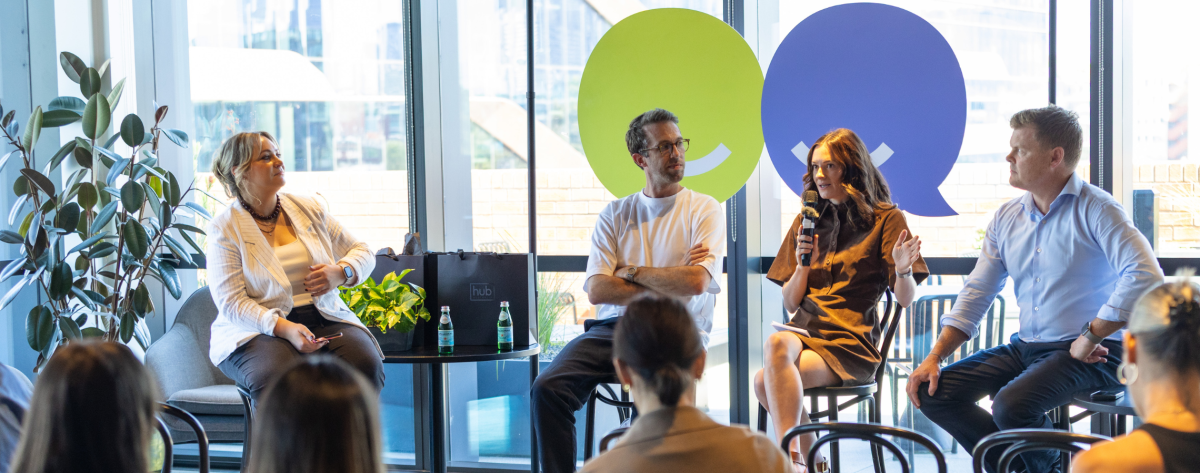
Sionainn is the founder of She HR Consulting. She was one of three panellists at Rethinking High Performance, the flagship conversation of Hub Australia’s WorkWell Week, hosted with In Good Company. Alongside her were Kim, CEO of Pocket Mentor, who spent eight years as performance coach to Formula One driver Oscar Piastri, and Jim Plunkett, co-founder of Telos Performance Partners, a former AFL player who later worked in leadership and people and culture at Melbourne Football Club.
Their backgrounds were different, but they kept reaching the same conclusion. High performance that wears people out doesn’t last. Here is what they shared.
High performance is a habit, not a buzzword
Kim began with a story from a government agency he joined after returning from Formula One. At an all-staff meeting of about 60 people, leaders announced a working group to discuss high-performance culture.
“Instead of sitting around and talking about high performance culture, you need to actually start working to create it,” he said.
His definition is simple. “High performance in the workplace is rocking up and doing the best that you can every day, and bringing the people around you to do that as well.” Do that consistently, over a year and then over many years, and high performance is the result.
Jim added that it looks different in every organisation. The common mistake is to respond to a missed target by doing more, and then more again, rather than stopping to assess where things actually stand. Teams do better when they agree on what performance means for them. “If we’re seeking perfection in anything,” he said, “I’d sit back and say good luck.”
The cost of always being on
Sionainn sees the cost of high performance going unmeasured across her client base. Employers ask for high output without accounting for the recovery it requires.
Part of the problem is hustle culture. The larger part, she argued, is how work changed after 2020. “COVID breached that divide between work and life,” she said. “The barrier between what is and isn’t work time has changed. We’ve probably all got our phones in front of us right now, and access to our emails 24/7.” Employees and leaders now carry far more at once than they did before, and burnout follows.
The data supports her. When asked what people raise most often in Pocket Mentor, Kim said just under half of all conversations relate to burnout and overwhelm, at work and in daily life. Relationships and accountability come next.
Culture is what you reward
Jim defines culture plainly: “what behaviour gets rewarded, what gets challenged and what you can get away with”. People become a product of that environment.
That puts the responsibility on leaders. “If you’re modelling the fact that you’re there at seven AM and you’re not leaving until seven PM,” he said, people learn that this is what leadership requires. There will be times when work genuinely demands that. The question is whether a leader’s everyday pattern is one the team could sustain.
He has seen the opposite in elite sport. After a loss, the reflex is extra training and longer hours, and the people who stay latest get rewarded. That isn’t always where the edge is, and it can push people towards burnout, because people are motivated in different ways. His advice to leaders is to understand where their people are, inside work and outside it. “We all take a bit of work home and we all bring a bit of home to work.”
Sionainn agreed. “It’s so much easier to help people on the journey of not burning themselves out if you, as a leader, are not burning yourself out.”
The case for imposter syndrome
All three panellists admitted to imposter syndrome. Kim said he has felt underqualified at the start of every job he has had. Sionainn said she felt it on stage.
Sionainn also offered a different way to think about it. “For me, the opposite of being an imposter is a level of complacency,” she said. The times she has been most certain, without that voice asking whether she was sure, are the times she has underperformed or made mistakes with real consequences. She quoted Socrates: “I know that I know nothing.” The doubt keeps you learning.
Jim feels it as nerves before he speaks. “If I didn’t have nerves, I didn’t care,” he said. A little unease, used well, can help performance.
AI should give people time back
On AI, Sionainn sees organisations splitting into two groups. Some are rushing ahead without considering the consequences for their people. Others refuse to use it at all, and miss the efficiencies it can offer. Her approach with clients sits between the two: “Let’s work smarter, not harder, but let’s look at it strategically. Say no to some aspects of it and yes to others.” She also urges small businesses to watch for dependency on tools whose prices could rise sharply once everyone relies on them.
Kim gave two examples of AI handing time back. Pocket Mentor runs with a team of two, and its CTO takes an hour-long run in the middle of most days. In the AFL, assistant coaches used to spend about six hours each tagging every event in a match, roughly 24 hours a week across four coaches. AI can now do that work, freeing coaches “to go and do the thing that you’re good at, which is coaching athletes and developing relationships”.
Jim’s point was that data can’t replace connection. “To be in the room, to have a conversation, to look people in the eye” is still where the most valuable work happens.
What they wish they’d known earlier
The panel closed with the advice each of them wishes they’d had at the start.
- Success isn’t linear. Careers have high points and low points. The job you expect to have will probably change, and then change again.
- Stop comparing yourself with other people’s highlight reels. Sionainn, a business owner with two young children, said her capacity is not what it once was. Building something that works for her, and comparing herself with the person she wants to be, has mattered more.
- Surround yourself with people who want to get better. The panel called this the best part of elite sport, and said it applies anywhere.
- Choose your hard. A nine-to-five is hard, and working for yourself is hard. Decide which hard you’re willing to live with, and commit to it.
Keep going
Watch the full conversation, download the Love Where You Work Report, and explore Pep Talks, mentoring and Relax Spaces on the WorkWell page of the Hub member portal.
With thanks to In Good Company, Pocket Mentor, She HR Consulting and Telos Performance Partners.